

Expert partial knee replacement solutions
David McKenna Orthopaedics works with patients across Droitwich, Worcester, Malvern, Pershore, and Evesham, to provide expert surgical solutions, helping you overcome knee complaints of every nature.
Find out if a partial knee replacement could be the solution for you
MAKO robot-assisted precision surgery
Personalised care for every patient
Over 10 years of orthopaedic expertise
Could a partial knee replacement be ideal for you?
When only part of the knee is damaged, you may be suitable for a partial knee replacement instead of a total knee replacement. The benefit of a partial knee replacement is retention of most of your own knee and a more natural feel to the knee replacement. Partial knee replacements involve a smaller incision, shorter operation and a quicker recovery.
Mr McKenna uses an enhanced recovery pathway with local anaesthetic infiltration and an adductor canal block. The combination of these interventions means less post-operative pain and a quicker recovery. Most patients having a partial knee replacement are able to go home the next day after surgery. Most patients have stopped using their crutches by the time they are seen at the 2-week follow-up.
These patients report better functional knee scores than total knee replacement recipients. Partial knee replacement recipients are more likely to “forget they have a knee replacement”. Between 20-40% of patients considering knee replacement surgery could be suitable for a partial knee. Not all knee surgeons are able to offer partial knee replacement.


The Oxford Unicompartmental Knee by Zimmer Biomet
Mr McKenna uses the Oxford Unicompartmental Knee by Zimmer Biomet. This has a 10A* ODEP rating and is the most commonly implanted partial knee worldwide. It is also the joint replacement that has been most researched. Mr McKenna was trained to perform the Oxford Unicompartmental Knee in the designer centre whilst he worked there as a consultant.
Get in touch to find out more.

Making the right choice for your wellbeing
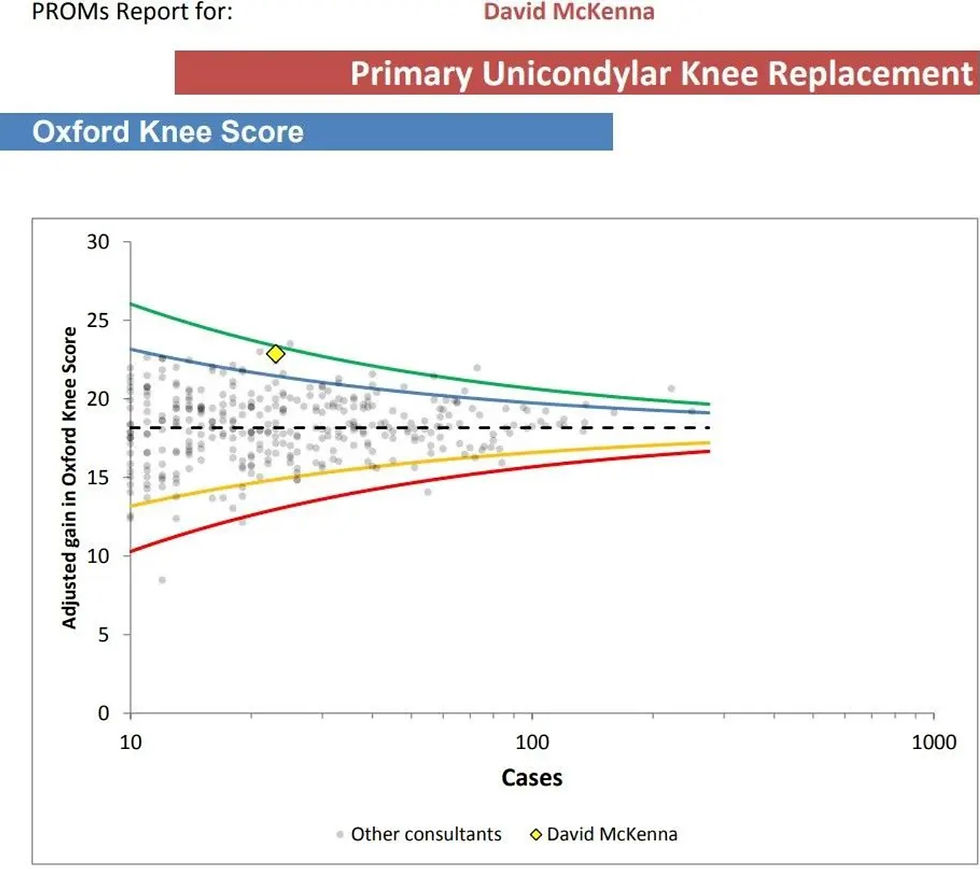
David McKenna’s PROMS (Patient Reported Outcome Measure) and revision rate data for partial knee replacement is shown in the graphs. This data is collected independently of the surgeon by the National Joint Registry. All hip and knee surgeons have access to their own data, very few publish their results.
First graph: PROMS. Every knee surgeon in the UK is represented by a dot. The dots to the right of the chart are surgeons performing higher volumes of operations. The dashed line is the average improvement reported by their patients. Surgeons placed above the dashed line are achieving better outcomes than those below the line. Surgeons above the blue line are achieving the top 2.5% of outcomes. Surgeons below the red line are outlier surgeons producing poor results. Mr McKenna's outcomes are represented by the yellow dot.

Second graph: Standardised Revision Rates. All UK knee surgeons are represented by a dot. Mr Mckenna is the green dot shown. The green line is the average number of revisions. Those surgeons below the green line have a better than average revision rate - their joint replacements are lasting longer before needing revision. Surgeons above the upper red curve are "Outlier" surgeons whose revision rates are so bad they are of concern.
“Dear Mr McKenna, my heartfelt thanks to you and your team for my successful knee operation. You have made such a difference to my pain free life.”
Improved mobility begins here
Call today to schedule your consultation and work with David McKenna Orthopaedics to find the right approach for you.
